09-06-2010
Labor Day
09-11-2010
Patriot Day
09-13-2010 05:30pm -
07:30pm
Board Meeting
09-27-2010 05:30pm -
07:30pm
Board Meeting
10-11-2010
Columbus Day
Hours of Operation
Monday - Friday
8:00 am to 5:00 pm
Emergency Phone
(626) 330-2126
Water Treatment
Since 1924 the District has relied on its well field located on Puente Avenue in the City of Baldwin Park as its primary source of providing pure and wholesome drinking water to our customers. In 1991, contamination levels of volatile organic compounds (VOCs) in the well field began to exceed the maximum contamination levels set by the California Department of Public Health (CADPH). The District took prompt action and in 1992, installed a 1,500-gpm air stripping facility to remove VOC’s (pictured below).

As a result of the continued migration of the contamination, the District installed an additional 1,500-gpm air stripping facility in 1995; the cost to install these facilities was over one million dollars.
Beginning in June 1997, several new chemicals not previously identified as a concern were discovered at the District wellfield. These chemicals are perchlorate, NDMA and 1,4-dioxane. Upon their discovery, the District took immediate action by removing these wells from service and purchasing water from adjoining water agencies at a great expense. At that time no proven treatment technology existed for the removal of these new chemicals from drinking water. In the summer of 1998, the District issued a nationwide Request for Proposal to find a treatment technology capable of treating these chemicals. In the fall of 1998, the District received a proposal from Calgon Carbon Corporation with performance-based assurances that these chemicals could be successfully removed. The Main San Gabriel Basin Watermaster, San Gabriel Basin Water Quality Authority, and Upper San Gabriel Municipal Water District funded the five million dollar project. On January 12, 2000, the funding agencies received reimbursement for the capital costs of this project from the parties responsible for the contamination. Construction began on the project during June 1999 and was completed February 2000.
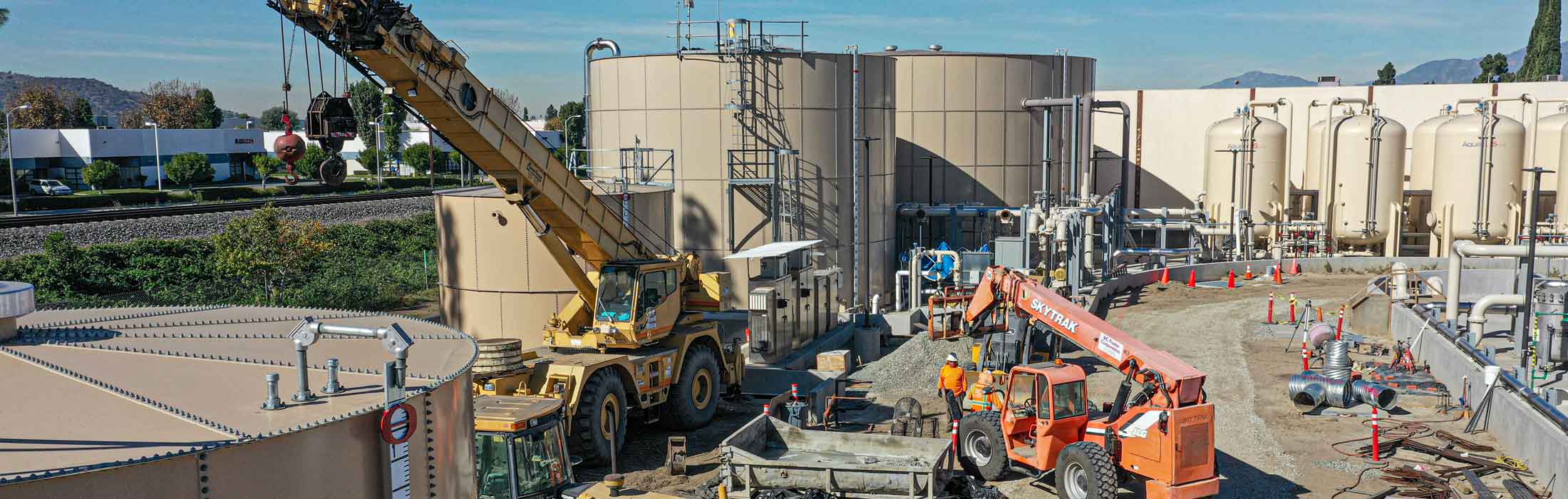
The District’s groundwater clean-up facilities consist of three wells located on Puente Avenue in the City of Baldwin Park, two parallel air stripping towers, one ion exchange system, one hydrogen peroxide injection system, two ultraviolet light reactors operating in series and a booster pump station. After treatment, the water is piped to the District’s Hudson Booster Station located in the City of La Puente and pumped into the District’s water system. The water is closely monitored and tested to assure that the water delivered to the public complies with all Federal and State drinking water regulations. The Treatment Plant has a capacity of 2,500 gallons per minute. This meets 100 percent of the District’s water needs.
The Treatment Facility includes separate treatment components that have been designed to treat specific types of contaminants. The air stripping towers are designed to remove VOC’s to below detection levels. The air stripping facilities consist of two air-stripping towers that are operated in parallel configuration, as the groundwater flows over the packing towers, the VOC’s are transferred from the water to the air flowing in a counter-current direction, the carbon vessel then removes the VOC’s in the air and the remaining clean air is then released to atmosphere. The treated groundwater flows by gravity into a 15,000 gallon wet well. The water is then pumped from the wet well using two vertical turbine booster pumps into the ISEP and UV systems.

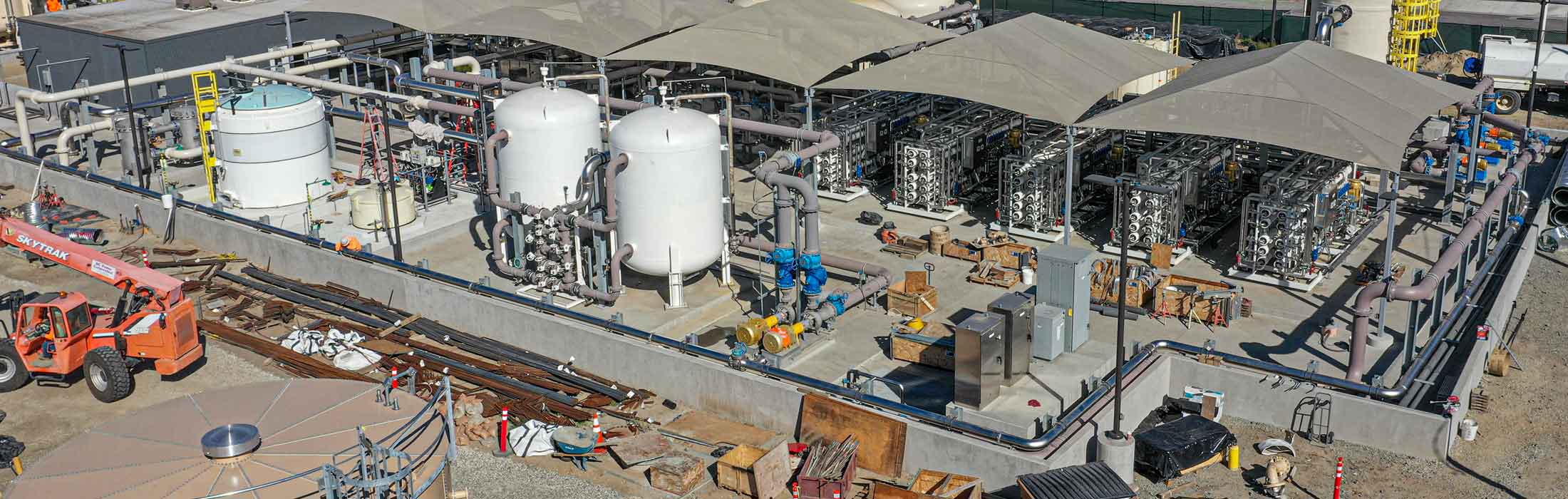
The ISEP unit, a continuous ion exchange module (pictured above), consists of 30 resin-filled vessels arranged on a carousel on a rotating frame, brine and rinse water systems, and process control system. The ion exchange columns are rotated through a sequence of operations including adsorption, displacement, entrainment, rejection, regeneration and rinse. These operations occur simultaneously as the carousel rotates. In simplistic terms, the ions of perchlorate, nitrate and bicarbonate are exchanged with chloride ions. The chloride ions come from salt or sodium chloride, which is delivered to the site by a commercial supplier and stored in a 72-ton tank. A brine waste stream of approximately 25 gpm is created and pumped to an existing brine waste line owned by the County Sanitation District of Los Angeles. This brine line conveys the waster water to the Sanitation District’s Carson plant for treatment. In 2009, the District completed the construction of its single pass ion exchange system. This new water treatment system (pictured below) uses resin material that is designed for the selective removal of the contaminant perchlorate.

This process is much like a household water softening system. However, this system does not require regeneration using salt water, like most other ion exchange processes. In addition, this new system produces virtually no waste water and is estimated to have the resin replaced once a year. The District plans to test the new treatment system in the near future and will work with the CADPH to obtain their approval to begin operations.
After passing through the ion exchange process, the water treated is injected with hydrogen peroxide prior to entry into the UV reactors. Each reactor tower contains a total of 384 ultraviolet (UV) lamps. (pictured below)

Water enters the reactor from one side, flows through and exits the reactor on the opposite side. Each lamp is horizontally mounted and crosses through the reactor while emitting ultraviolet light, which is absorbed by the NDMA and 1,4-dioxane. Destruction of 1,4-dioxane requires the addition of hydrogen peroxide, which forms hydroxyl radicals in water. NDMA destruction is also enhanced by the addition of hydrogen peroxide. Under the influence of UV light, the hydroxyl radicals oxidize 1,4-dioxane. NDMA is destroyed by direct photolysis when exposed to UV light. Testing has indicated that the final breakdown products of both NDMA and 1,4-dioxane are nitrite, carbon dioxide and water.
The treated water exiting the facility typically has no detectable levels of VOC’s, perchlorate, NDMA or 1,4-dioxane and consistently complies with CADPH water quality standards. Water exiting the treatment facility is chlorinated with a free chlorine residual of at least 0.2 mg/L through the distribution system.
After the water has gone through the three treatment processes it is delivered to the District’s Hudson Booster Station. This booster stations pumps water into the District’s water distribution system.
The District firmly believes that this treatment plant not only provides a safe and reliable supply of drinking water to our community, but also preserves a natural resource for future generations of area residents.
Last Updated (Thursday, 10 June 2010 04:54)